I hope you all had a very Merry Christmas. It's been, like, 70 degrees in Florida. Dying to go to the beach, but it has been a tad chilly to go lately.
So, I haven't posted on my blog for a while mostly due to being stressed about life. I used my blog for a while as way to unwind, but lately it just hasn't been fun. For a few months I tried to use it as "an example of my writing" in order to help obtain a job and show the world I am committed to a project. But then it became very work-y and I lost a lot of my energy to write for a while.
I don't want to quit writing, but maybe reformat and do something differently. The past 6 months have been personally challenging and I feel like a lot of my projects had to be set aside to get through more pressing matters such as my home and health.
Although few people actually read these entries, I want to continue to grow and initiate discussion. Please comment any and all topics you're interested in reading about! It always inspires and most definitely motivates me to keep going,
Let's go into the New Year together, each day stronger and better than we were before!
Outside of the usual manga, gaming or film blogging routine,
it is time now for something completely different. I recently attended a play
at The Laboratory Theater of Florida, which greatly resonated with me on many
different levels: Hand to God.
HAND TO GOD
Written by Robert Askins, Hand to God is about a tiny
youth group that creates puppets to perform skits for church. Pastor Greg
asked recently widowed Margery to run it, enlisting her teenage son
Jason, his crush Jessica and rowdy Timmy. None of the kids take the group
seriously, but Jason harbors a deep attachment to his puppet Tyrone, which he
never removes from his hand. As conflict stirs Tyrone speaks more, consuming
Jason’s thoughts and controlling his actions. And yes, there is blood.
Conflict
I am straddling a fine line here since don’t want to spoil
the contents of the play. It is definitely worth seeing, no matter your
religious affiliation. Putting comedy aside, I think Hand to God poses
questions about expression in church, an issue every character handles
negatively. Nobody knows how to healthily express love or desire while Margery
and Jason exclusively mourns the loss of a family member.
A shot of the stage. You wouldn't believe how it looks later.
Pastor Greg and Timmy lust for Margery—both of them inappropriate
suitors given their respective statuses as leader and minor. I take it that
Timmy comes from a rough upbringing and yearns for a maternal figure. Jason
struggles with abandonment, questioning Margery’s love for him and his deceased
father.
Aside from family drama, Jason faces the challenges of adolescence and crushes on Jessica.
Tyrone becomes his outlet to express things he could never do himself, divulging
secrets and devilish thoughts. As Tyrone becomes more vocal, it allows a lot
of room for the audience to speculate whether the puppet is possessed or if this
unassuming teen has deep-rooted psychological problems.
Personal Anecdotes about Expression
Assuming at least the adults have a genuine faith, I found
it interesting that the characters hardly seek help from God let alone someone
outside of the conflict. Margery insists Pastor Greg keep quiet than call
the police or even other members of the congregation. This proves to be more
damaging in the long run.
The lack expression and being unable to convey information
reminds me of the time I spent around Christian people during high school and
college. This is not to say Christians or other organized religions are bad,
but I guess I can somewhat relate to oppression around religious
people.
I know that many seek a church for a sense of community,
comfort and self-betterment. From firsthand experience, I’ve received plenty of
backlash from religious people for simply disagreeing on certain subjects and
not fitting their image of what a
good, faithful person is.
For years I felt it was easier to just shut up around some Christian people who were very close to me in order reduce
conflict. As a result, I snapped last year because my personality was
compromised far too long. I felt my own version of Tyrone emerge. But damn, it
sure feels good to let him out.
I’ve heard the hushed whispers of controversy within church
and youth group, which in retrospect deeply saddens me. Instead of being
ostracized as sinners, I really wish people didn't gossip. It frustrates me that the people who needed the most help were sometimes demonized.
THE DEVIL IS IN THE DETAILS
Alright, I know you aren’t here to read about my personal stories, but I do want to
applaud the cast at The Laboratory Theater of Florida once more for a wonderful
performance. This was my first time at this theatre and I am certainly marking
my calendar for their upcoming shows. Anyway a few comments on individual
performances:
From L to R: Albertson, Sanders, Tyrone, Coe, Weymouth, Johnson & Director Nykkie Rizley
I adored Steven Coe’s performance as Jason & Tyrone. At
the beginning I felt it was difficult to distinguish the differences between
the boy and puppet, but it makes sense with how the character changes. Once
Tyrone awakened, he became the most powerful person(?) in the room.
There was something about Pastor Greg that tugged at my brain.
It was like I somehow knew this person. After the show I spoke with Ken Johnson and wanted to make sure I haven't met him before. His acting was highly convincing and there was something so familiar about his on-stage persona.
Jessica is in my opinion the most likeable character and I
couldn’t help but find Sofia Weymouth’s take on her to be so cute. Jessica is sort
of a punk take on the girl next door, with attitude and eye rolls galore. I was
especially impressed during, er, a very
special scene by how Weymouth’s speech transitioned between puppet
to Jessica and back again.
I think TJ Albertson and Shelley Sanders mesh well together
and had the strongest character dynamic. I was delighted
by how the Timmy and Margaret held themselves in front of the youth group versus their private
conversations.
GO SEE THIS SHOW
If you couldn’t tell, I thoroughly enjoyed The Laboratory
Theater of Florida’s performance of Hand
to God. Go buy tickets. If you’re in Southwest Florida and you’ve got a bit
of free time the next couple weeks, I urge you to attend. No excuses, click this link.
I haven’t written about movies recently and well, there’s something finally worth discussing. Upon recently watching Mr. Smith Goes to Washington, I've concluded that I am not a Frank Capra fan.
No disrespect to the man, this is still an awesome movie! However, I certainly don’t jive with Capra’s story direction. You may remember a little blurb about It's a Wonderful Life last Christmas, but after seeing Mr. Smith these feelings I've discussed in the past have only been reinforced.
The Premise
Our lovely protagonists working to pass a bill.
The fantastic Jimmy Stewart stars as Jeff Smith, a seasoned leader of the Boy Rangers, who is appointed to represent in the Senate. Smith is well-loved, good guy who would make for an excellent image in the Senate, but he is selected primarily for his lack of experience in politics, ultimately making him easy to manipulate.
His fellow state senator, Joseph Paine played by Claude Rains, was a good friend of Jeff's father. Buuuuuut, he secretly supports corrupt businessmen despite his good reputation. More importantly though, his daughter is hot. And totally single. (Smith really likes her.)
As Smith begins his new career, his assistant Saunders takes him for a complete fool. It really brings her to question her career, personal life and the American political machine. But Smith's optimism and respect towards women really grows on her...
Although Smith is what us modern folk call a n00b, he proposes to build a new Boy Rangers camp exactly where his political opponents plan to build a money-grubbing dam. The film focuses on Paine and his partners first attempting to trick Smith into supporting the dam to later wreck every aspect of his life as he defends his camp project.
Pacing & Art Direction
The thing with old films is that they are much slower than modern movies. I don't count that against the film, but I love how dialogue driven the movie is. It felt interesting throughout and every scene contributes in some way. Time isn't wasted.
There's a montage prominently listed in the opening credits which I looked forward to seeing. The montage is the only part of the film that feels slowed down as Smith soaks in the monuments of D.C. when he first arrives. It poured patriotism into my heart and demonstrates how much of a good boi Smith is.
I am particularly impressed by the use of sets and scenery. I love that the scenes at the Lincoln Memorial were actually filmed there. There were many pivotal moments in that location. The Senate is an incredible set that gets a lot of miles with interesting angles and feels energetic. I am most fond of the revolving spectators and being able to see reactions from the crowds.
One of my favorite shots is when Smith has a conversation with Paine's daughter. The camera is set on a closeup of Smith's hat as he fumbles around, unable to contain his feelings for her. Not quite dramatic as this scene, but the hat fumbling continues later in the film as Smith expresses romantic feelings.
Another detail I adore: Smith's 5 o'clock shadow that appears near the end of the filibuster.*mic drop*
Story & Acting
So what has made me realize that I'm not a Frank Capra fan is that his films are too happy. Is that such a thing? I don't consider myself an pessimistic person, but parts of the movie were so cheesy. I'm glad I watched It's a Wonderful Life first, knowing he is a bit of a cornball, but I couldn't help but cringe when Senate-henchmen were injuring children and Smith's general positivity & naivety. Although I loved watching the movie, perhaps I don't agree with the interpretation of the message? I do believe we can make great changes in America, but Smith is such an unrealistic character that I cannot imagine surviving our government.
What's not to love about Jean Arthur??
Apparently it took a while for Capra to find a someone to buy Mr. Smith Goes to Washington and it also received poor reception from politicians and journalists alike. During pre-screenings they would complain that the film portrayed them as villains and crooks. With the current midterm elections, this film couldn't have been re-released through Fathom Events at a more perfect time because it does show how awful 99.9% of our politicians are. An older couple who sat a few rows ahead of me in the empty theatre commented, "We really wish more people showed. This movie is too real."
Aside from my issues with the film feeling too unrealistic, there's an all-star cast. I am a huge Jimmy Stewart fan, but Jean Arthur steals the screen. She is such a strong female lead and well-respected character for her career and intelligence. Not to mention, she's a beauty with such a cute, croaky voice and a strong fashion sense. Arthur can go one scene as a powerful person into another as the comedic centerpiece. Hands down, best character.
To not dismiss the talent of the other actors, but I recognized nearly everyone in the film and they all felt convincing. The children were also stellar as I often giggled at well-executed jokes and lines.
CONCLUSIONARY THOUGHTS
I loved and hated It's a Wonderful Life. Capra is just too positive, but he has such great art direction and he certainly knows how to cast. I highly urge you all to give Mr. Smith Goes to Washington a chance. It's well paced and the characters are charming or equally awful in their own ways.
One of my favorite subgenres of manga are genderbenders. Some of the most popular within this genre: Hana-Kimi, Ouran High Host Club and Princess Jellyfish. As much as I love Ranma ½ and consider it to be a classic, I’m seeking older titles and "deep cuts" to analyze how gender is represented.
If you don't know Ranma 1/2, you don't know anime.
Stop reading this and go pick up the anime or watch
it on Hulu Plus.
Although I identify as a cisgender heterosexual female, I've always felt bothered by gender roles my whole life. Since manga is one of my favorite forms of art and entertainment, I find myself deeply invested in Japanese culture and have spent years reading about female roles. From my research, I can say that Japan is further behind the States when it comes to gender equality and the acceptance of the LGBT community. Not to say Japan is archaic by any means, but I think the way women are idealized and expected to act are not healthy either.
A Bit About Riyoko Ikeda
The first piece I'm looking at is Claudine, created by Riyoko Ikeda. Ikeda is famously known for The Rose of Versailles. What started as a manga about a girl raised as man has spurred into both an anime and many, many musicals. The cool part about the musicals is that they have been performed by the Takarazuka Revue, an organization composed of all-female performance troupes.
I wanna watch Rose so badly...
it's just as pretty looking as Claudine.
Claudine is significant because it is one of the first transgender manga, published in 1978. The 1970s marks an era for early yaoi and yuri manga, but it wasn't until the 1990s that homosexual manga became mainstream.
Claudine
Taking place in early 20th century France, the namesake of the story, Claudine, was born a female but always felt strongly male since a young age. He spends a lot of time correcting family, friends and the village that he is male-- no semblance of a woman in the way he speaks, acts and holds himself.
No one but his classmate Rosemarie believes in Claudine's identification as a male. However he is never fond of Rosemarie, no matter how deeply she loves him. She only seems to cause him trouble. Claudine is both incredibly popular and bright, but his mother takes him to a therapist as an effort to "correct" her daughter.
There are three major romantic arcs to the story. Claudine first falls in love with a young, live-in maid when he's 15 years old. The two become friends and Claudine comforts the girl with a kiss after she receives the news of her father's death. Unfortunately his mother walks in on this moment and quickly sends the girl back to her village.
A few years later he falls in love with a librarian, an unmarried woman. The two become close, but she rejects his confession because Claudine is a "girl." Unfortunately due to drama and confusion, the librarian's brother kills her and Claudine's father, something I'll further detail in the next section. Rosemarie is partial to blame for this disaster.
Claudine's third and most pivotal love interest, Sirene, met a few times in the past and they reunite in college. Sirene convinces her family to allow her to live with her "friend Claudine", but they are more than just friendly. These secret lovers are content until Claudine's brother asks Sirene out. Sirene pursues his brother.
Feeling betrayed, Claudine makes a final attempt at romance and asks Sirene to choose him or his brother. The story ends in Claudine's suicide.
Opinion & Analysis
Overall I liked Claudine, but I think it suffers due to its brevity. It's about 100 pages and I would have loved to see more development with each love interest. I hate to chastise the manga for this reason, but the fact remains a transgender story was published during a time this theme was few and far between.
What I like about Claudine is that it feels realistic. By no means can I say I relate to someone who is transgender, I've witnessed and heard about events similar to those seen in the story.
The lack of understanding is well captured throughout the narrative, but I found it interesting that Claudine continued to reject Rosemarie, even though she is the most accepting of his identity. I think Claudine dislikes her because he feels treated like a mere token. He says, "I'm not interested in being a spectacle" to Rosemarie when she invites him to her birthday party early on. Claudine learns she has a crush on him and that she bragged they were dating to all her girlfriends.
Claudine's first romance is a display of innocent love, which establishes his liking of women. When he crushes on the librarian, the relationship is very one-sided and he doesn't confess until provoked by the librarian's brother. The librarian never took the relationship past friendship and this particular rejection was hard to read. I've seen plenty of homosexual or trans friends develop a crush on someone who could never reciprocate romantic feelings due to incompatible orientation.
The librarian's brother is not a great character, but is interestingly the lover of Claudine's father. I was mildly confused and couldn't well predict this plot. Skimming over the first few pages, there is brief mention that his father didn't spend much time dating and reluctantly married, which lightly hints he is gay.
I do like the idea of tying sexual orientation between Claudine and his father. From the beginning, the manga emphasizes the stark similarities between the two while explaining that Claudine's brothers take after their mother. I wish Ikeda had more time to set up the complex issues and relationships around the father's homosexuality to develop a better subplot.
The romance with Sirene is incredibly frustrating because I totally see her as the girl who "experimented in college." The fact she would even doubt her feelings for Claudine is selfish since she probably just used him as an excuse to escape a cloying family-life. I wouldn't consider Claudine's brother traitorous because he never knew the two had a thing going on, but Sirene should have ended her romantic relationship with Claudine sooner than hide her affections for his brother.
Claudine gives Sirene an ultimatum which is a giveaway to him pondering suicide. Quite sad considering that suicide rates are higher for sexual minorities. To no surprise, Claudine gives up because nobody can truly love and celebrate him the way he needs to be. I'm glad the therapist accepts Claudine's identity during the final pages, but it's still an incredibly dissatisfying ending.
Conclusionary Notes
Unrelated to gender analysis, Claudine is extremely stylish, oozing with beautiful shoujo eyes and details. I've wanted to delve into Ikeda's stories for a while now. I'm glad I picked up this short manga since I got a lot out of it. Ready for more!
If you have any genderbend manga suggestions, please comment below or message me on my new FaceBook account. Please please please spread word, share this blog and like my page! I have a few more manga to discuss in future entries of The Dynamic of Gender, but I am open to suggestions.
Did you enjoy Claudine? What points do you agree or disagree with me about? Do you think Claudine was foolish at any point during her romances? Should she have given Rosemarie a chance?
I most recently looked into my long manga blacklist (which is a never ending log of volumes I own and intend to buy) and felt in the mood for a one-shot story. What better choice could I make but choose Voices of a Distant Star?
Published by Vertical Inc, Voices is a manga adaptation of a 2002 anime created by Makoto Shinkai. Unsurprised upon such revelation, I didn't know there was this anime prior to researching this blog. I'm definitely going to watch, but seeing early 2000s-CGI in the trailer hurt me a just a bit. Nobody to blame but myself for the pain since I'm not a huge fan of the animation technique. I don't mean to rag on it, I'm sure it's a delightful piece!
The Concept
What if you lived out of this world and any communications with home took hours, days or years? Voices of a Distant Star explores the relationship between two middle schoolers, Mikako and Noboru. Mikako is sent on a mission into space to defend Earth from aliens. She pilots an Evangelion-styled mecha and is definitely not fighting aliens that remind me of the Angels of Eva... But fighting foreign creatures is not the focus of the story!
The protagonists share a deep connection and clearly see each other as more than just friends. Mikako embraces her abilities to pilot with a mission to defend Earth. Noboru embodies a vision for the future, never forgetting his promises to Mikako. Each of them have a positive future in mind, but Noboru focuses his goals on a more personal level than Mikako's selfless action to leave her Earth-life behind.
Doki-Doki ドキドキ
As the crew space crew travels, communication with Earth is prioritized for critical, mission-based information. The pilots are able to send personal messages to their friends and families at the cost of time. While stationed on Mars, an exchange takes half a day, which eventually extends into years as the team travels to the edge of the solar system.
However the consequences for traveling light years also bends the progression of time. What is perceived to Mikako as a few days or months during her mission means that a certain number of years has already passed on Earth. Her thoughts and emotional maturity do not progress as the story continues because she still is the middle schooler from the beginning.
I found Noboru to be the more interesting character, although he's just an average guy when comparing Mikako and her abilities. He ages at least ten years over the course of the story and develops much more than she. Noboru briefly distracts himself from loneliness. Although Mikako's messages are few and far between, Noboru's emotions pour whenever he receives a transmission.
I felt a sense of true love when Noboru broke up with his high school girlfriend and got his act together once years of Mikako's silence breaks. He then decides to follow his heart and work every bit of his life into helping Mikako than remain depressed. I find it noble that he takes the tougher route in attempt to reunite with his crush than accept mediocrity via living a simpler life.
The message of this manga: Love transcends time.
Long-Distance Relationships
I only purchased Voices because I heard high praises, only knowing I'm getting into a unique sci-fi piece. But damn. I couldn't have picked this at a better time.
Not too long ago my boyfriend spent 5 weeks working in the literal opposite side of the country. Physical distance certainly affects a relationship, but I'm incredibly grateful that we had the chance to communicate each day we were separated. It made time move more quickly and remind me of the good in this world since we were presented with multiple challenges during our separation. Not only did we build each other, his absence reinforced my feelings and how important he is to me.
I tried doing long-distance with someone else last year, but it wasn't the physical distance that led to my unhappiness. I'm so glad to have made change and recently experience an even greater physical distance to use as a basis of comparison for both scenarios. It helped me realize what a genuine, loving relationship feels like.
More Shinkai Please
I love Shinkai's works I've had a chance to read to date. Heck, you should take a peek at my thoughts on She and Her Cat, a brilliant manga and anime he created as well. If anyone has any other Shinkai recommendations, please send them my way!
Even though I could have addressed more elements to Mikako's story, I still stand behind Noboru being the better character. The other pilots Mikako studied and worked with were more interesting than she, but do not as strongly resonate what I got from Noboru's story.
You know what I'm sick of? Bad movies. And yes! In order to stop the madness of shit-movies, I want YOU to go to the movie theatre! Not only should you go to the theatre, but you should buy tickets to something that isn't the blockbuster of the month.
Why I'm Annoyed
If ya'll can't tell. I go see lots of unusual films, which you may have read in past entries. You'll typically see me mention, "There's just myself and *fewer than 10 people* in the theatre." Perhaps you can call me a hipster movie-goer?? However, I rarely see a film I really dislike. If I'm going to spend $13 to see an evening show (unfortunately my work schedule is never conductive to seeing a matinee...), I'm making sure it's something I know I'll enjoy or have an appreciation for even if it lacks in certain areas of filmmaking.
So my rage begins with Fathom Events. I guess this isn't anyone's fault, it's just a matter of demographics and theatre traffic. The other day I had my heart completely set on seeing Masaaki Yuasa's recent anime movie, The Night is Short, Walk On Girl. This movie was frequently advertised to me whilst browsing the internet and I frequently check for new Fathom Events anyway.
Yuasa is a phenomenal director and artist. I'm a huge fan of a bunch of anime he's worked on: Tatami Galaxy, Ping Pong: The Animationand most recently the Netflix exclusive Devilman Crybaby. These are all awesome anime, I highly recommend checking any of them out! For being a grossly underrated director, I was shocked to see that his movie made to American theatres for a specialty showing. That struck me odd, but it all started to add up in my head...
After finishing my 11 hour work day, I open the Regal Cinemas app to double check the time-- I should've had a half hour to get my butt from work to the theatre and catch the movie in good time. But the show wasn't listed. Confused, I checked the Fathom Events website to only find that the closest theatre playing The Night is Short, Walk On Girl is 90 minutes from me. I lost my shit. Absolutely furious.
The Remedy
After having my fit, I felt upon the principle of supporting movies deserving of good money, I went to a showing of Generation Wealth. Generation Wealth is a documentary by Lauren Greenfield who created one of my favorite documentaries of all time, The Queen of Versailles. If you haven't seen The Queen of Versailles, I highly recommend it, the family you will watch had waaaaay too much money and everything they did hurts. Whenever it goes on Netflix, I watch it ten times over.
I'm glad I saw Generation Wealth because that would have been the only opportunity for me to see it on the silver screen because that too had a very limited run. To my demise, I was the only person in the theatre. How depressing.
Just Stop Picking Dumb Movies
I noticed a lot of buzz around The Meg, which I kind of get "movie of the month" vibes from. I don't want to knock on "dumb" movies because I LOVE so many silly films, but you have to know what you're getting into before seeing a "dumb" movie. The number of complaints I saw on social media about the movie was immaculate! I was surprised to see so much discussion around it.
I'm one of those people frantically swimming away from this film.
I saw so many tweets along the lines of, "There's no good movies this August, may as well go see The Meg." HELL NO! You don't know how many people I've refuted the importance of seeing good v. "dumb" movies, shouting to them, "GO SUPPORT THE FIRST FULL ASIAN-CAST MOVIE IN 25 YEARS, Crazy Rich Asians!!"
Special gems like Crazy Rich Asians are so incredibly rare and I'm so glad Kevin Kwan's novel was adapted into a movie. I've been a fan of the novel for years now and was joyed when I heard it was going to be made into a film. Heck, I even went to a special early showing of it before the official release, I was that excited!
I am as in love with this movie as Nick and Rachel are in love with each other...
Most importantly, it is actually a well-crafted romantic comedy. Romcoms have a reputation for being extremely cheesy and reinforce the ideals of the male gaze. Of course there was some cheese in Crazy Rich Asians, but I think the various stories all came to fruition and you really fall in love with the characters and their problems.
IN CONCLUSION,
Please choose wisely which movies you see in the theatre. Just know that where your money goes influences Hollywood and if we continue to feed stupid movies, they'll cling onto a trend and beat it into your soul until your soul itself extinguishes. All I really want out of this is greater recognition for smaller gems and for them to be more available because all films, no matter how good or bad, are truly meant to be seen on the big screen.
"Liz, I don't go to the theatre because it will eventually be up on Netflix!" Dude. Support the film industry more directly for the genres and creators you want to make more of what you love. Netflix is a wonderful way to sample new things, but occasionally go out when you can afford it and give your dollars to a theatre.
I've been a bit busy lately being sick with mono, going to the hospital n' stuff, fixing the entire plumbing system in my house and now figuring out drywall and paint... meaning that I've been hardly seeing people or doing anything of personal significance. However, there is one video game that has consumed me on days I just don't feel like doing anything: The Talos Principle
The Talos Principle combines two things I love: puzzles and myth. I've always been kind of obsessed with puzzles games, having the hugest crush on Prof. Layton and enjoying the puzzles more than the action of the Resident Evil series. A friend insisted I try TTP
when it came out, so I've finally slow-poked myself into playing years
later. And goodness. I'm kicking myself for not playing it sooner.
Big Questions, Few Answers
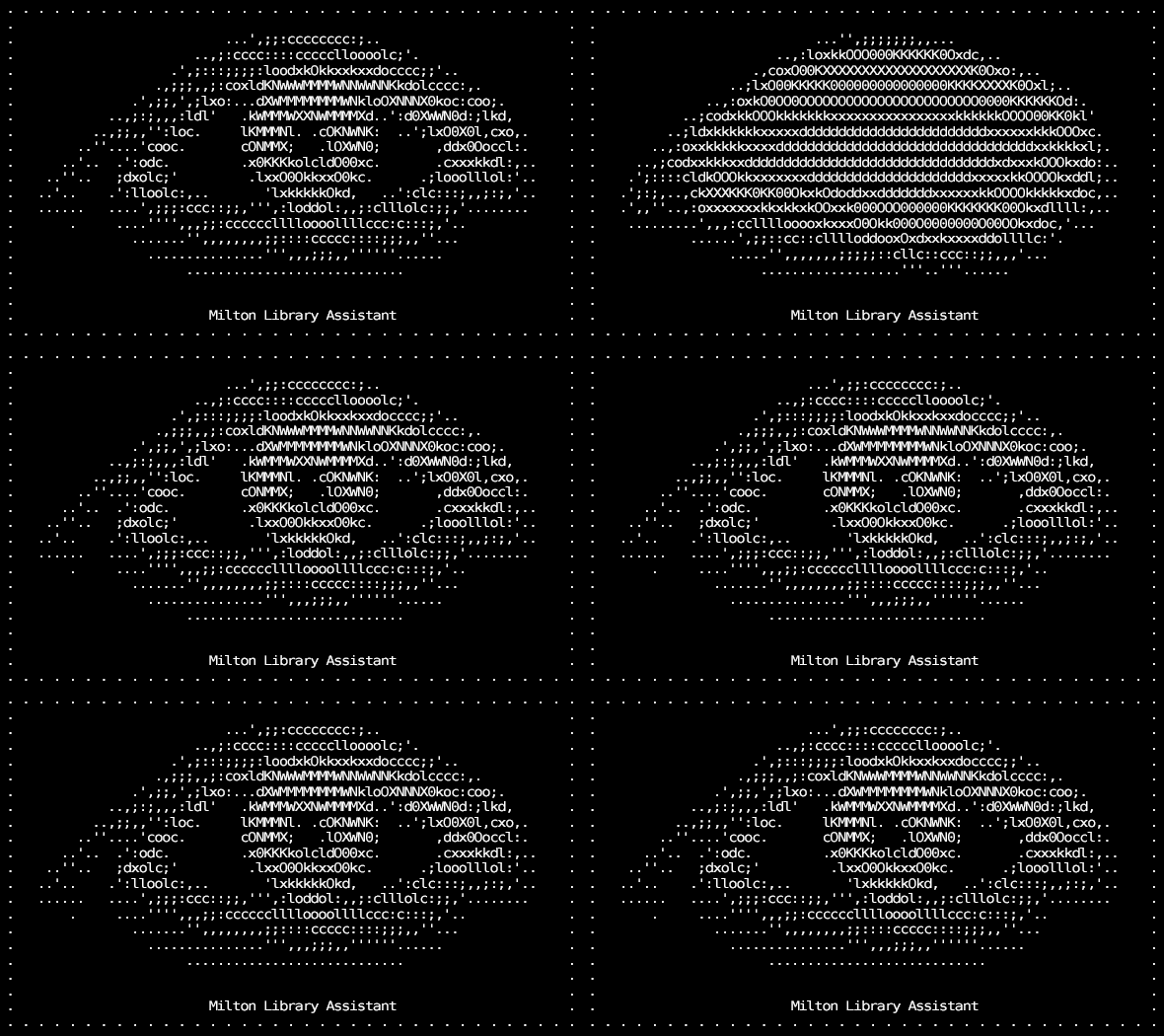
TTP is first a literal puzzle game that turns everything you witness and experience into a huge philosophical question. You play a robot in a virtual world, void of other beings. The other major beings(?) are Elohim, a disembodied voice who is presumably God, and a computer program, the Milton Library Interface.
MLA is hands down the best character.
Elohim says this universe was created just for the player, but he heeds you to not climb this glaring tower between the worlds. Within each world there are multiple levels with a handful of puzzles and tricky stars to find. These worlds are themed after ancient philosophers as well as Greek, Egyptian, and Christian mythology.
I totally dweebed out over every bit of detail in the game. As I grew up, I spent a lot of time buried in my father's books about ancient history and mythology, reveling in diagrams of pyramids and learning of different rituals and stories. When I was little I even tried writing hieroglyphics and studied the Greek alphabet.
Rage-inducing levels. A bird's eye view of how this can be a real cluster for your brain.
There are two major stories I see play out in The Talos Principle. Plot A is the goal to conquer these puzzles, finding your purpose and reason in the virtual reality. However, I would consider Plot B to be the entries you read in the MLI catalogue. Not only does this computer contain stories interpreting mythology, you slowly unearth what has happened in the real world, revealing harrowing truths about humanity.
It's Funny How We Speak of Reality...
I feel like sometimes a puzzle game is just a puzzle game... but I like to think of The Talos Principle as an experience. It may have taken me some six months to play and finish, but I had to be a particular mood to play. Often I'd play for hours on nights that I just wanted to be alone with my thoughts.
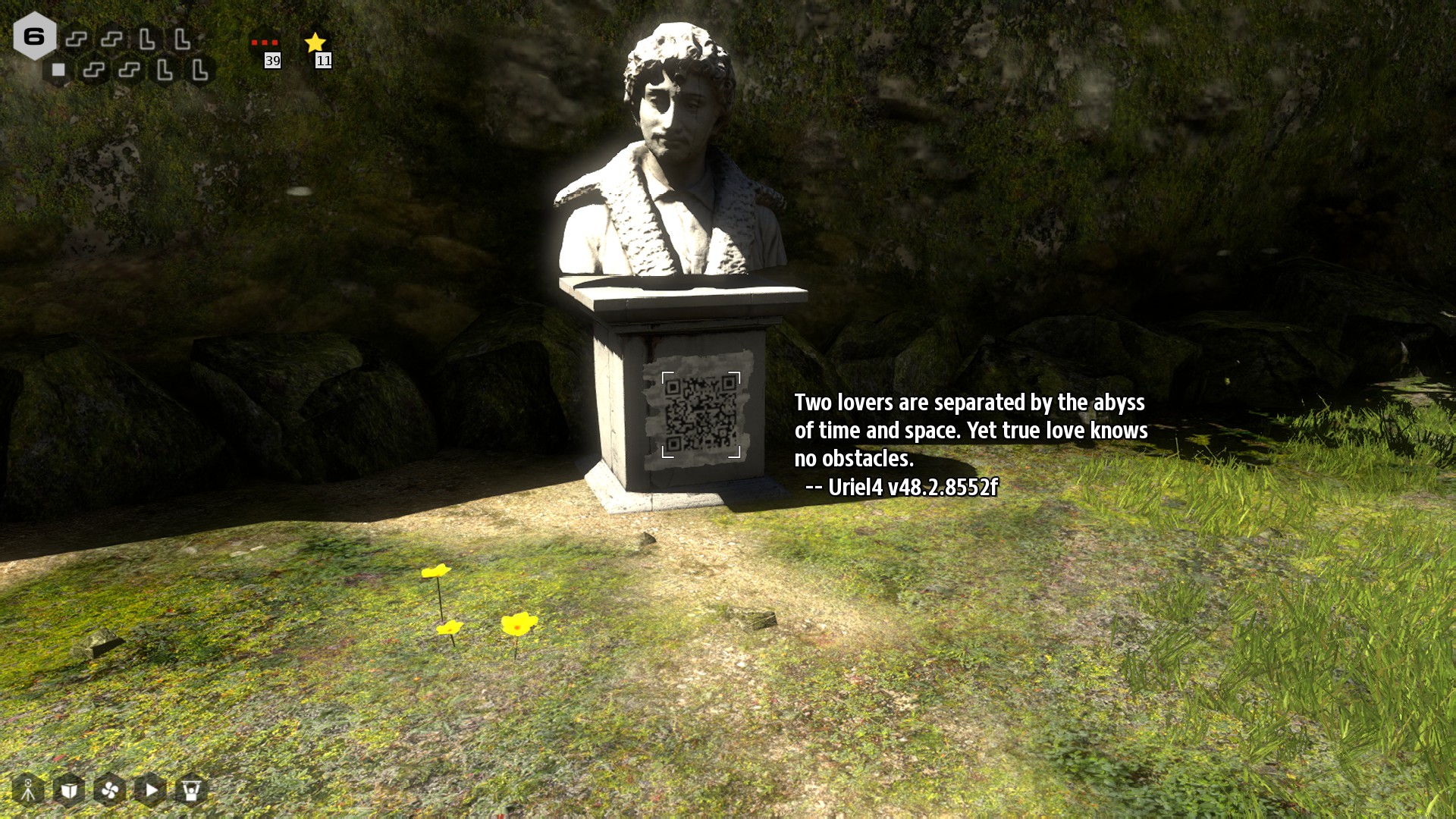
And if you turn around you'll see a statue of a woman on a floating isle...
There is very little dialogue and each level has a certain ambience, leaving a lot of character to be found in the environment. I loved finding small stories that are told in the world. Some of it I made up in my head, pretending people once lived in the old ruins that you explore. Other stories are direct and symbolic, bringing me to tears.
A puzzle game this serene, this beautiful can't go without me rage-quitting sometimes. For most of the final world, my friend Dan held my hand and did most of it for me. Puzzle games are meant to be chill for me, but when it becomes frustrating to a point it stops being fun, I need another brain to reel me back in. Working on it together was a much greater experience than sitting alone and getting worked up about a silly puzzle.
CONCLUSION
I've gone through a couple of emotional lows this year and TTP carried me through some of it when I needed to be removed from my own reality. While helping me, Dan made a point that we see through to every ending. They're all very interesting and I felt starkly different emotions given the scenario.
The completionist ending is quite a delight and I would definitely make sure you have you friends play after you fully beat the game. It's such a rewarding ending that bleeds into other people's games!! I didn't have any friends who played on PS4, so I'm really hoping some of you will pick it up and see my mark in The Talos Principle.
I'll try to catch up with some extra blogs this month, but considering my illness and the state of my home, I can't make any promises. I'll do my best!